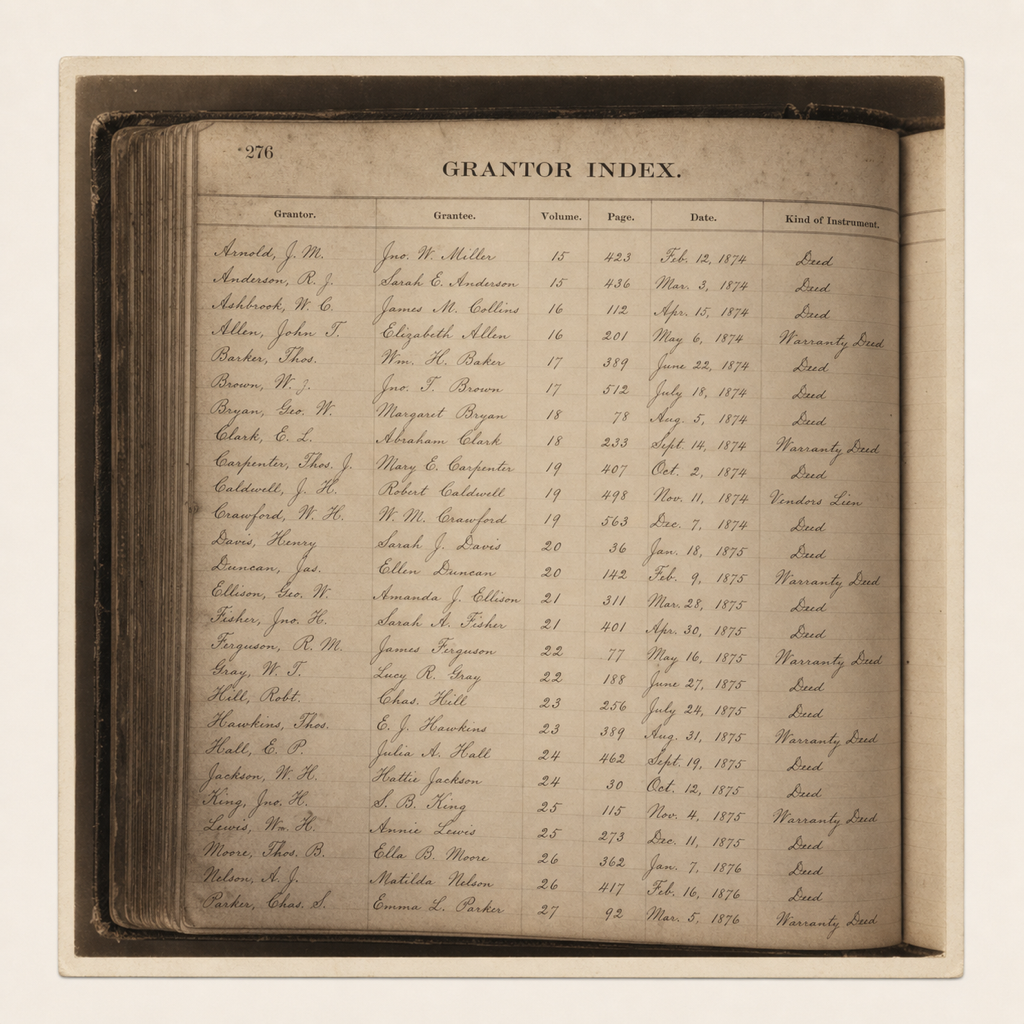
Title research is slow because the work is fragmented across three different layers - records, expertise, and fieldwork - and most teams have to assemble that themselves on every job. We run all three under one roof.
Layer 1
The county data layer.
For every county we source, the clerk's index is already OCR'd, the parties and legals are normalized, the chain is pre-walked, and the document set is pre-vetted by a AAPL-member senior landman (often RPL or CPL). That work happens once, up front. By the time you call us, the heavy lifting on the county is finished.
Today the layer carries hundreds of thousands of recorded instruments per county across the Texas counties we source - deeds, oil & gas leases, mineral conveyances, releases, affidavits of heirship, probate filings, easements, and ROWs - with wells, permits, parcels, and ownership stitched alongside.
Layer 2
In-house abstractors.
Texas landmen on staff, AAPL members, many holding RPL or CPL credentials. They take your tract, filter the standing index to it, construct the chain, write the abstractor's notes, and stitch wells, leases, and ownership. Every workbook is reviewed and signed off by a senior landman before it ships.
This is where the judgment lives. The data layer makes it fast; the abstractor makes it correct.
Layer 3
Field network.
Some records still only live at the courthouse - older deed volumes, hand-indexed mineral books, probate files, plat books, oil & gas lease books in unconsolidated counties. When the job needs them, we dispatch from our network of independent AAPL-member Texas landmen who work each county.
They pull the volumes, capture them at archival resolution, and the searchable PDFs land in your secure folder the same day, with a vol/page manifest.